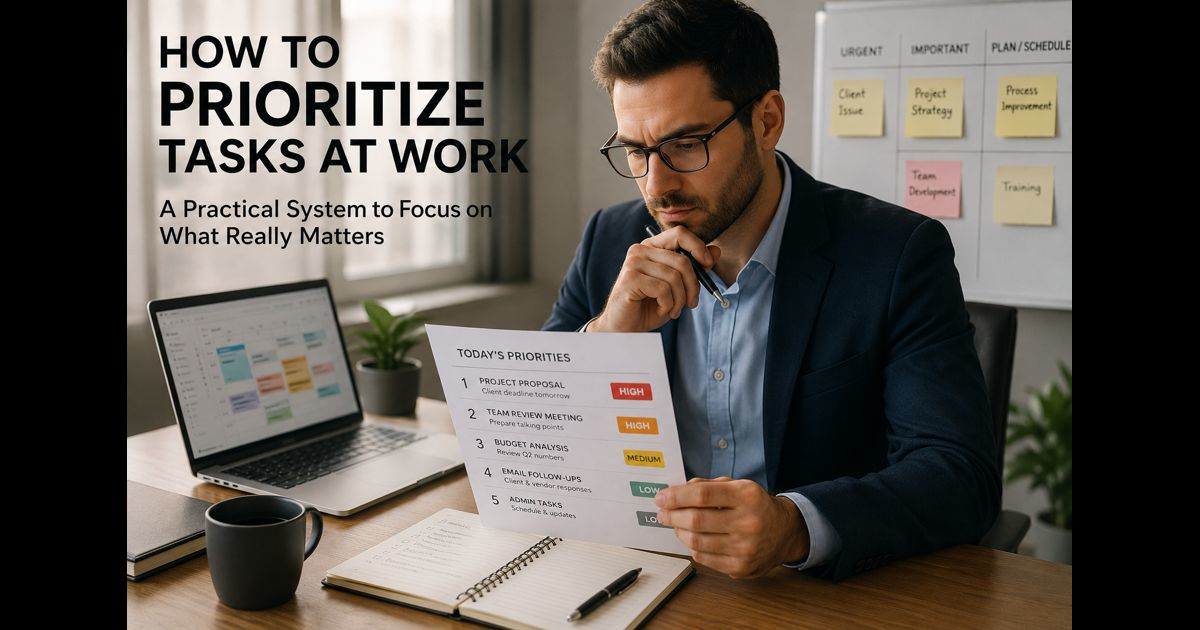
Prioritizing tasks at work means making a clear decision about what deserves attention now, what needs a scheduled time, what can wait, and what should be reassigned or clarified. It is not simply completing the nearest task or responding to the loudest request. Good prioritization protects important work from being displaced by activity that only appears urgent.
A useful priority reflects the consequences of delay, the value of the result, the people affected, and the order in which work must happen. When those factors are visible, a crowded workload becomes a set of decisions rather than an unmanageable list.
Start With One Complete View of the Work
A priority system cannot work when tasks are scattered across email, meetings, messages, notes, and memory. Collect current commitments in one list before deciding their order.
Include:
- Work with fixed deadlines
- Requests from managers, clients, or colleagues
- Project actions and follow-ups
- Recurring responsibilities
- Work waiting on approval or information
- Tasks that prevent someone else from moving forward
Write each item as a specific action with a clear result. “Prepare client update” is easier to assess than “client.” “Approve homepage copy before launch” is easier to assess than “website project.”
This step often reveals that a long list contains different kinds of work. Some items require immediate action. Others require a decision, a reply, a meeting, or a future calendar slot. Treating every item as a task to complete today creates false urgency.
Assess Consequences Before Choosing an Order
A deadline matters, but it is not the only reason a task should move to the top. Ask four questions about each item:
- What happens if this is delayed?
- Does it protect revenue, customers, safety, compliance, or a committed delivery date?
- Is another person or team unable to proceed until this is finished?
- Does completing it create meaningful progress toward an agreed objective?
The answers distinguish truly important work from work that is merely visible or convenient.
For example, answering a routine message may take two minutes, but it may have little consequence if handled later. Reviewing a proposal due tomorrow may require focused attention and affect a larger decision. A brief approval may also be high priority when several colleagues are waiting for it.
Priority is therefore not the same as effort. A small decision can be more important than a large assignment when it removes a serious blocker.
Separate Urgency From Importance
The Eisenhower Matrix remains useful because it separates time pressure from significance.
| Task type | Appropriate action |
| Urgent and important | Do it promptly |
| Important but not urgent | Schedule protected time |
| Urgent but less important | Delegate, simplify, or respond within limits |
| Neither urgent nor important | Remove, defer, or question its value |
The strength of this method is not the four boxes themselves. It is the pause before reacting. A request can be urgent for the person sending it while still having limited impact on the wider work.
Important but not urgent work deserves particular protection. Planning, preparation, risk reduction, relationship-building, skill development, and quality review are often postponed because they do not demand immediate attention. Repeatedly postponing them eventually creates avoidable emergencies.
Check Dependencies and Sequence
Some work cannot start until another task is complete. A priority list that ignores this sequence can produce busy days with little real progress.
Look for three dependency questions:
- What must be completed before this can begin?
- Who is waiting for an answer, decision, file, or approval from me?
- Which action would unblock the most valuable next step?
A task may move higher in the order because it removes an Shine Frik obstacle for several people. Conversely, a task may move down because it cannot be completed yet. In that case, the correct action is often to request the missing information or set a follow-up date—not to leave it as an unclear top priority.
Teams work more reliably when ownership, status, and blockers are visible. The principles behind modern task management are especially useful here: coordinated work depends on more than assigning tasks. People need enough context to understand what is moving, what is stuck, and who can make the next decision.
Use a Simple Scoring Method When Choices Are Close
When several tasks seem equally important, compare them using the same criteria. Score each item from 1 to 5 for:
- Impact: How much does the outcome matter?
- Time sensitivity: Is there a real deadline or consequence of delay?
- Dependency value: Does it unblock people or subsequent work?
- Effort: How much focused time is required?
- Confidence: Is the required action clear and ready to begin?
High-impact, time-sensitive tasks that unblock others normally deserve early attention. A task with high impact but low clarity may need a short clarification step before it can be scheduled properly.
The point is not to make every decision mathematical. It is to avoid choosing work based only on habit, anxiety, or whoever contacted you last.
Decide What “Done” Means Before Starting
A task can consume far more time than necessary when the required standard is not clear. Before starting, define the result in one sentence.
Examples:
- “Send the revised budget with the approved figures and notes on the two open decisions.”
- “Confirm the delivery date with the supplier and update the project owner.”
- “Review the draft for factual accuracy, legal risk, and missing information.”
A clear completion point prevents unnecessary polishing and makes delegation easier. It also prevents a common mistake: starting work that looks productive without knowing whether it will solve the actual problem.
Put Priorities on the Calendar
A ranked list shows importance; a calendar shows whether the work can realistically be completed. Schedule focused work, meetings, reviews, and communication time separately.
Reserve your best concentration period for work that requires judgment, writing, analysis, or problem-solving. Place routine replies, status updates, and administrative actions into shorter grouped periods where possible.
Avoid scheduling every available minute. A plan with no room for unexpected requests is fragile. Leaving a reasonable buffer allows genuine emergencies to be handled without abandoning the whole day.
For larger assignments, schedule the next concrete milestone rather than placing a broad project name on the calendar. “Draft the outline,” “verify the data,” and “request approval” are easier to begin and track than “finish project.”
Limit the Number of Active Priorities
A long list may contain many important responsibilities, but it cannot contain ten first priorities. Choose a small number of outcomes that must move forward today, then identify the first action for each.
For many roles, one demanding priority and two supporting priorities are more realistic than an overloaded daily plan. The exact number depends on meetings, responsibilities, and the amount of uninterrupted time available.
Limiting active priorities is not ignoring other work. It is an honest recognition that attention is finite. A visible waiting list is better than repeatedly switching between unfinished tasks.
Respond to New Requests Without Losing Control
New work should be assessed before it displaces planned work. When someone assigns a task, clarify:
- What outcome is needed?
- What is the actual deadline?
- What happens if it is completed later?
- Which current commitment should move if this becomes the top priority?
- Is there someone else who can handle part of it?
A direct response can be professional and useful: “I can begin this today, but I am currently completing the report due at 3 p.m. Which item should take priority?” This gives the requester the information needed to make a trade-off instead of silently creating an impossible workload.
When priorities change, update the list, calendar, and affected people. A changed decision that remains invisible becomes a missed expectation.
Review Priorities at a Consistent Time
Prioritization is a repeated practice, not a decision made once each morning. A short review at the start and end of the day is usually enough for individual work. Teams may also need a brief review before a project handoff, weekly planning session, or major deadline.
During the review:
- Mark completed work
- Move unfinished work deliberately rather than automatically
- Reassess deadlines, dependencies, and capacity
- Remove work that no longer matters
- Identify the next action for blocked items
- Confirm whether any promised delivery dates need communication
This prevents outdated commitments from remaining high on the list simply because they were important last week.
Common Prioritization Mistakes
Treating every request as urgent
Urgency loses meaning when everything is marked urgent. Reserve it for work with a real time-sensitive consequence.
Using due dates as the only rule
A due date does not show impact, dependency, or the amount of work required. Consider all four before setting the order.
Starting with the easiest task
Quick wins can be useful, but they should not consume the time needed for work that requires deeper focus.
Keeping priorities private
When other people depend on the work, communicate changes early. Shared visibility prevents duplicated effort and missed handoffs.
Confusing activity with progress
A full day of messages, meetings, and small tasks may leave important outcomes untouched. Review whether the work moved a meaningful responsibility forward.
A Practical Daily Priority Routine
At the beginning of the day, collect new work and review existing commitments. Identify deadlines, consequences, and dependencies. Choose the few outcomes that require progress today, then block time for the first meaningful action.
Before accepting new work, compare it with the current plan and make the trade-off visible. At the end of the day, update the list, communicate any changed expectations, and prepare the first priority for tomorrow.
The goal is not to complete everything immediately. It is to make sound decisions about limited time, keep important work moving, and ensure that colleagues understand what will happen next.